
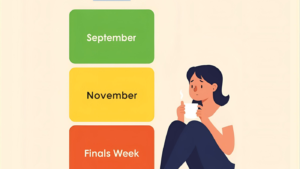
“In my Junior year, I ended up in the campus health center with a panic attack. The nurse asked me what I had eaten that day, and I realized I had only had coffee. I thought I was ‘grinding.’ I was actually destroying myself. It took me a full semester to recover.”
It starts slowly.
First, you skip one gym session to study. Then, you start eating lunch at your desk while reading flashcards. Then, you stop replying to your friends’ texts because you are “too busy.”
Suddenly, it’s 2 AM on a Tuesday. You are staring at a blank Word document, exhausted, but unable to sleep. You feel guilty for resting, but too tired to work.
This is Student Burnout.
It is not the same as “stress.” Stress is having too much to do. Burnout is feeling like nothing you do matters.
In 2025, with the pressure of internships, AI, and social media, burnout is hitting students harder than ever. Here is how to recognize the signs before you crash, and a realistic plan to get your life back.
Phase 1: The “Honeymoon” Phase (The Trap)
Burnout doesn’t start with failure; it starts with ambition. You sign up for 18 credit hours. You join 3 clubs. You say “Yes” to everything. You feel like a superhero.
-
The Warning Sign: You start sacrificing sleep to “get ahead.” You think, “I’ll sleep when the semester is over.”
Phase 2: The “On-Set” of Stress
The superhero feeling fades. You start forgetting small things. You get irritated when your roommate asks you a simple question.
-
The Symptom: “Revenge Bedtime Procrastination.” You stay up late scrolling TikTok not because you are happy, but because you feel like you have no control over your daytime hours.
Phase 3: Chronic Exhaustion (The Crash)
This is the danger zone. You miss a deadline, and instead of panicking, you just feel… numb. You stop caring.
-
-
The Reality: Your grades start to drop, not because the work is hard, but because your brain has literally shut down to protect itself.
-
The Recovery Plan: The “3 R’s” Approach
You cannot “work harder” to fix burnout. You have to work differently.
1. Reset Your Boundaries (The “No” Muscle)
You need to quit something. Right now. Look at your schedule. What is the one thing that gives you the least value but takes the most energy? (Maybe it’s that club you only joined for your resume, or that extra shift at work). Action: Send the email today. “I need to step back to focus on my academics.”
2. Rest (The Real Kind)
Scrolling Instagram is not rest. Watching Netflix while checking email is not rest. True Rest requires your brain to be “offline.”
-
The 1-Hour Rule: For one hour a day, put your phone in a drawer. Go for a walk without music. Cook a meal. Draw. Do something analog.
3. Reconnect (The Social Cure)
Burnout thrives in isolation. When we are stressed, we hide. Force yourself to have one “non-productive” conversation a day. Call your mom. Go get coffee with a friend and don’t bring your laptops. Remind yourself that you are a human being, not a GPA machine.
How to “Study” When You Are Burnt Out
You still have exams. You can’t just stop.
-
Use the Pomodoro Technique: Work for 25 minutes, break for 5. It is less intimidating than “Study for 4 hours.”
-
Lower the Bar: Instead of aiming for an A+, aim for “Done.” A finished ‘B’ paper is infinitely better than an unfinished ‘A’ paper.
-
Leverage Tools: Use our Ethical AI Guide to help you outline essays so you aren’t staring at a blank page.
Conclusion: You Are More Than Your Resume
The world will not end if you take a nap. The world will not end if you get a B-minus.
Your mental health is the engine that powers your career. If you let the engine explode now, you won’t make it to the finish line.
Be kind to yourself. You are doing enough.