
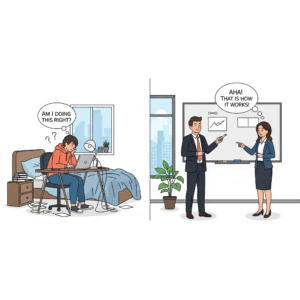
When I graduated, all I wanted was a remote job. I pictured myself working from a beach in Bali. But when I finally landed a remote gig, the reality hit me. I sat alone in my bedroom for 8 hours a day. I didn’t know my coworkers’ names. I felt isolated and stuck. I realized that what looks like freedom can sometimes feel like a trap.
It is the question that divides every dinner table in 2025.
Personally, I found that working from home made me feel lonely. I missed the lunch breaks with my friends at…
On one side, you have the “Digital Nomads”—tech-savvy graduates who argue that commuting is a waste of time, office clothes are a scam, and they are more productive in their pajamas.
On the other side, you have the “Old Guard”—managers who insist that “real work” only happens when you are staring at each other across a desk.
But for you—a recent graduate looking for your very first job—the stakes are higher. You aren’t just trying to get work done; you are trying to build a career from scratch.
Is taking a Remote job straight out of college a dream come true, or is it a career trap?
Here is the honest breakdown of the pros, the cons, and the hidden “Proximity Bias” that no one tells you about.
The Case for Remote Work (The Dream)
Let’s be honest: Remote work sounds amazing.
1. Financial Freedom
The average cost of commuting, buying lunch, and purchasing “business casual” clothes is roughly $5,000 to $8,000 a year. If you work from home, that money stays in your pocket. For a fresh grad on an entry-level salary, that is a huge raise.
2. Deep Focus
Offices are loud. Between the sales team ringing a bell and your coworker asking about your weekend, it’s hard to code or write. At home, you control your environment. You can enter “Deep Work” mode and finish tasks faster.
3. Location Independence
You can work for a tech startup in San Francisco while living in a cheaper city (or your parents’ basement). You get the big-city salary without the big-city rent.
The Case for In-Office (The Hard Truth)
However, there is a dark side to starting your career remotely. It’s called “The Learning Silo.”
1. You Miss “Osmosis Learning”
In an office, you learn just by existing.
-
You overhear a senior manager negotiating a deal on the phone.
-
You see how the design team sketches on a whiteboard.
-
You watch how the CEO handles a crisis.
This is called Osmosis Learning. You absorb skills without trying. Remote workers only learn what they are explicitly taught in a scheduled Zoom meeting. They miss the “accidental” lessons.
2. The “Proximity Bias” is Real
This is controversial, but the data backs it up: People promote the people they see. If your boss sees you working late, or if you grab coffee together in the breakroom, you build a relationship. If you are just a square on a screen, you are easily forgotten.
-
Internal Link: This connects back to our guide on Networking for Introverts—it is much harder to network through a screen.
3. Feedback is Slower
In an office, if you are stuck, you swivel your chair and ask, “Hey, does this look right?” Remote, you have to type a message on Slack. Then you worry, “Am I annoying them?” So you wait. You spin your wheels for 3 hours on a problem that could have been solved in 30 seconds.
The Verdict: What Should You Choose?
If you have two offers on the table—one Remote, one In-Office—which one should you take?
For Your First 2 Years: Choose the Office.
I know, I know. It’s not the trendy answer. But here is why:
Your first job is not about production; it is about education. You are there to learn Soft Skills, office politics, and industry jargon.
-
In the Office: You get mentorship. You get lunch with the boss. You build a network that will last 40 years.
-
Remote: You get tasks. You complete tasks. You log off. It is transactional, not relational.
The “Hybrid” Compromise
If you can find it, Hybrid (3 days in, 2 days home) is the gold standard. It gives you the social connection you need to get promoted, with the deep focus time you need to stay sane.
Summary
I eventually moved to a hybrid role—3 days in the office, 2 days at home. For me, it was the perfect balance. I needed those office days to learn from my mentors, but I needed the home days to get deep work done. Don’t underestimate the value of face-to-face time when you are just starting out.
If you are a self-disciplined introvert who already has a strong portfolio, Remote might work.
But for 90% of graduates, the office is an accelerator. Commuting sucks, but being isolated in your first year sucks more.
What do you think? Is Remote work a trap for juniors, or is the Office dead? Let me know in the comments below!