
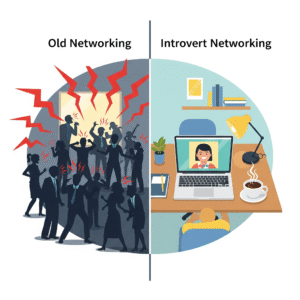
My first networking event was a disaster. I walked into the hotel ballroom, saw 100 people in suits talking loudly, and immediately walked into the bathroom to hide. I spent 20 minutes looking at my phone before leaving. I thought I wasn’t cut out for business. But then I realized that networking doesn’t have to be loud to be effective
Here is the fifth article for your “Career Prep” category.
This is excellent content for AdSense because it is relatable and keeps users reading by promising a low-stress solution to a high-stress problem. I have included a “script” section, which users love to copy/paste (increasing value).
Networking for Introverts: How to Build Connections Without Feeling Awkward
If the word “Networking” makes you want to hide under your blanket, you are not alone.
Most students imagine networking as walking into a loud room full of strangers, wearing a stiff suit, and awkwardly handing out business cards while trying to sound important.
For an introvert, that is a nightmare.
But here is the good news: That is not what networking is anymore.
In 2025, the best networking doesn’t happen at loud parties. It happens in quiet, one-on-one conversations—exactly the kind of environment where introverts thrive.
If you hate small talk but need a job, here is your introverts-only guide to building a powerful network without ever feeling fake.
The Introvert’s Superpower: Listening
Extroverts are great at talking. Introverts are great at listening.
This is your secret weapon. People love to talk about themselves. If you can ask one good question and then genuinely listen to the answer, people will remember you as “smart” and “insightful”—even if you barely said a word.
Stop trying to be the “life of the party.” Start trying to be the best listener in the room.
Strategy 1: The “Warm Email” Technique (Zero Social Pressure)
The hardest part of networking is the approach. Walking up to a stranger is terrifying. Sending an email? That’s easy.
You can build 90% of your network from your bedroom using LinkedIn. But you have to do it right.
The Mistake: Sending a generic connection request with no message.
The Fix: Send a customized note that asks for advice, not a job.
The “Low-Stress” Script (Copy This)
“Hi [Name], I’m a student at [University] and I’ve been following your work on [Project/Article]. I love how you approached [Specific Detail]. As someone hoping to enter this field, I’d love to ask one quick question about how you started. No pressure at all, but thanks for connecting!”
Why this works:
-
It’s specific: It proves you aren’t a bot.
-
It’s low pressure: “No pressure at all” makes them more likely to reply.
-
It’s flattering: You complimented their work.
Strategy 2: The “Informational Interview” (One-on-One)
Introverts often hate groups, but love deep conversations. Use that.
Instead of going to a career fair, ask a professional for a 15-minute “virtual coffee” chat. This is a controlled environment.
-
You control the time (15 mins).
-
You control the questions.
-
There is no background noise.
What to ask during the call:
Don’t worry about small talk about the weather. Jump straight to the topic you both care about: Their career.
-
“What is the one skill you use every day that you didn’t learn in college?”
-
“If you were graduating today, what would you do differently?”
Strategy 3: Volunteer for a “Job” at Events
If you have to go to a real-life networking event, here is the ultimate hack: Volunteer to help.
Ask the organizers if you can work at the registration desk or help set up chairs.
-
Why: It gives you a purpose. You aren’t just standing there awkwardly holding a drink; you are “working.”
-
It forces people to talk to you. (“Hi, here is your nametag.”)
-
It is an instant icebreaker.
Strategy 4: The “Follow-Up” is More Important than the Meeting
Extroverts are great at the initial meeting, but often terrible at the follow-up. This is where introverts win.
After you meet someone (online or offline), set a reminder to email them 24 hours later.
-
“Thanks for the chat, [Name]. I really liked your point about X. I’m going to look into that course you recommended.”
Then, email them again 30 days later just to say hello.
-
“Hi [Name], just wanted to give you an update—I took that course you mentioned and learned a lot! Thanks again for the tip.”
This is called “nurturing the network.” It requires zero social energy—just organization.
Conclusion: You Don’t Have to Change Your Personality
Today, I have a strong network of mentors, and I met almost all of them via email or one-on-one coffee chats. I still hate loud parties, and that’s okay. You don’t need to change your personality to build a career; you just need to change your strategy
You do not need to become a loud, outgoing person to get a job.
In fact, many CEOs prefer hiring introverts because they are thoughtful, focused, and self-sufficient. Stop trying to “fix” your introversion. Lean into it. Send that thoughtful email, ask that deep question, and let the extroverts have the loud parties. You’ll be busy getting hired.