
 I froze. The interviewer asked, ‘Tell me about a time you failed,’ and my mind went blank. I sat there for ten seconds of awkward silence before stammering something about being a perfectionist. I didn’t get the job. I walked out of that room promising myself I would never be blindsided again. That’s when I discovered the STAR method
You have your resume ready. You bought a nice shirt. You memorized the company’s “About Us” page.
But then, the interviewer asks you a question that freezes your brain: > “Tell me about a time you failed at something.”
This is a Behavioral Interview Question. Unlike technical questions (which test what you know), behavioral questions test how you act. Employers believe that your past behavior is the best predictor of your future performance.
For fresh graduates with little work experience, these questions can be terrifying—but they are actually your best chance to shine.
Here are the top 10 behavioral questions you will face in 2025, and exactly how to answer them using the secret weapon: The STAR Method.
The Secret Weapon: The STAR Method
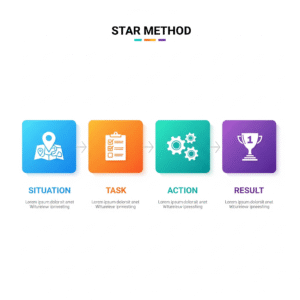
Before we look at the questions, you need a formula to answer them. Never answer with a simple “Yes” or “No.” Use this structure:
-
-
S (Situation): Briefly describe the context.
-
T (Task): Explain what problem you had to solve.
-
A (Action): (Crucial) Describe what you specifically did.
-
R (Result): Share the positive outcome or what you learned.
-
1. “Tell me about a time you handled a conflict with a coworker or classmate.”
What they are asking: Do you hold grudges, or do you solve problems logically?
-
The Trap: Do not blame the other person.
-
The Good Answer: Talk about how you listened to their side, found a compromise, and finished the project together.
2. “Tell me about a time you failed.”
What they are asking: Are you honest? Do you learn from mistakes?
-
The Trap: saying “I never fail” or giving a fake failure like “I work too hard.”
-
The Good Answer: Pick a real, small failure (like missing a deadline on a sophomore project). Focus 80% of your answer on how you fixed it and how you organized your calendar differently afterwards so it never happened again.
3. “Describe a situation where you had to work under a tight deadline.”
What they are asking: Do you panic or prioritize?
-
The STAR Answer:
-
Situation: “During finals week, I had three papers due on the same day.”
-
Action: “I broke each paper down into 2-hour blocks and created a strict schedule. I prioritized the hardest paper first.”
-
Result: “I finished all three 12 hours early and maintained a 3.8 GPA that semester.”
-
4. “Tell me about a time you showed leadership (even if you weren’t the manager).”
What they are asking: Do you take initiative?
-
The Good Answer: Talk about a time a group project was stalled because no one was talking. Explain how you organized a Zoom call, assigned roles, and got the team moving again.
5. “Give an example of a goal you reached and tell me how you achieved it.”
What they are asking: Do you know how to plan?
-
The Good Answer: Do not just say “I wanted an A.” Talk about a side project, like training for a 5k run or learning Python over the summer. Show them the process, not just the win.
6. “Tell me about a time you had to persuade someone to do things your way.”
What they are asking: Can you influence people without being bossy?
-
The Good Answer: Focus on data. “My team wanted to use PowerPoint, but I suggested Canva. I showed them a side-by-side comparison of how much time Canva would save us on design. They agreed, and we finished 2 days early.”
7. “Describe a time you had to learn something quickly.”
What they are asking: Are you coachable?
-
The Good Answer: Mention a specific software or skill (e.g., Excel Pivot Tables) you had to learn for a class project overnight. Emphasize the resources you used (YouTube, tutorials) to teach yourself.
8. “Tell me about a time you solved a problem using data.”
What they are asking: Do you make decisions based on facts or feelings?
-
The Good Answer: “I noticed our student club’s Instagram engagement was dropping. I looked at the ‘Insights’ tab and saw our audience was active at 6 PM, not 2 PM. We shifted our posting schedule, and engagement went up 40%.”
9. “Tell me about a time you worked with a difficult team member.”
What they are asking: Can you work with different personalities?
-
The Trap: Don’t call the person “lazy.”
-
The Good Answer: “I had a partner who wasn’t submitting work. Instead of getting mad, I asked him if everything was okay. He told me he was struggling with the research part. I swapped tasks with him—he did the editing, I did the research—and we got an A.”
10. “Tell me about a time you went above and beyond.”
What they are asking: Do you do the bare minimum, or do you care about quality?
-
The Good Answer: Describe a time you did something that wasn’t required, like creating a “User Guide” for the next student taking over your club role, just to be helpful.
Summary
The next time I faced that question, I was ready. I told a story about a group project I messed up in my Junior year, and exactly how I fixed it. The interviewer didn’t look bored—she was nodding. I got the offer the next day. Preparation is the only cure for anxiety.
The key to nailing these questions is preparation.
You don’t need to memorize 10 different stories. Pick 3 or 4 “Core Stories” from your college life—one about a group project, one about a failure, and one about a success.
Usually, you can twist one story to answer five different questions. If you prepare your “Core Stories” using the STAR method today, you won’t freeze up in the interview tomorrow.