
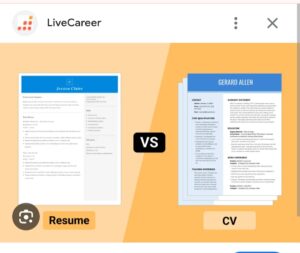
When I applied for my first job in the US, I made a huge mistake. I sent a 4-page document listing every single class I took since high school. I called it a ‘CV’ because that’s what we called it back home. I didn’t get a single interview. It took a mentor sitting me down and saying, ‘They didn’t read past the first page’ for me to realize that in the corporate world, brevity is power.
You are ready to apply for your dream job. You click “Apply,” and suddenly the portal asks you to upload your CV.
Panic sets in. Is that a Resume? Do I need to write a new document? Why are there two names for the same thing?
If you are confused, you are not alone. “Resume” and “CV” are often used interchangeably, but depending on where you live and what job you want, they can be completely different documents. Sending the wrong one can get your application tossed in the trash.
Here is the definitive guide to the difference between a Resume and a Curriculum Vitae (CV), and exactly which one you need in 2025.
What is a Resume?
The word Resume comes from French, meaning “to summarize.”
A resume is a short, concise document used for job applications in the US and Canada. Its goal is not to tell your whole life story; its goal is to make you look like the perfect match for a specific job.
-
Length: Strictly 1 to 2 pages maximum.
-
Focus: Competency-based. It highlights skills and work history relevant to the specific role.
-
Structure: Flexible. You can change the order of sections to highlight your strengths.
Think of a Resume as a marketing flyer. You only include the highlights that will sell you to the recruiter.
What is a CV (Curriculum Vitae)?
CV stands for Curriculum Vitae, which is Latin for “course of life.”
A CV is a comprehensive, static document that lists everything you have ever done in your professional and academic career. It is strictly chronological and details your entire history.
-
Length: As long as it needs to be (often 3 to 10+ pages).
-
Focus: Credential-based. It highlights education, publications, research, awards, and affiliations.
-
Structure: Static. It almost always follows a set order (Education first).
Think of a CV as a biography. It is a complete record of your academic life.
The Key Differences at a Glance
If you are skimming, here is the cheat sheet:
| Feature | Resume | CV (Curriculum Vitae) |
| Meaning | Summary | Course of Life |
| Length | 1–2 Pages (Strict) | Unlimited (Comprehensive) |
| Goal | Get a job interview | Get an academic grant or tenure |
| Content | Tailored to the specific job | Static (lists everything) |
| Used For | Corporate/Industry jobs (US) | Academic/Medical/Research roles |
| Format | Bullet points, concise | Lists, citations, detailed |
The “Location” Trap: Where do you live?
This is where 90% of the confusion comes from. The definitions change depending on your country.
1. In the United States and Canada
The distinction is strict.
-
Applying for a corporate job (Marketing, Tech, Sales)? Use a Resume.
-
Applying for a PhD, Fellowship, or Professor role? Use a CV.
2. In the UK, Europe, and New Zealand
In these regions, the word “Resume” is rarely used. They call everything a CV.
-
However, their “CV” is actually just a Resume.
-
If you are applying for a marketing job in London, and they ask for a “CV,” do not send a 10-page academic document. Send a standard 2-page document (what Americans call a Resume).
3. In India, South Africa, and Australia
These countries use the terms interchangeably. Generally, for private sector jobs, a 2-page summary is expected, regardless of whether they call it a CV or a Resume.
Which One Do You Need Right Now?
To decide which document to build, answer these two questions:
Question 1: Are you applying for a job in Academia, Medicine, or Research?
-
Yes: You need a CV. Focus on your publications, research projects, grants, and teaching experience.
-
No: Go to Question 2.
Question 2: Are you applying for a job in the US/Canada?
-
Yes: You need a Resume. Keep it under one page if you are a student, two pages if you are experienced.
-
No (Europe/Asia/etc.): You likely need a document called a “CV,” but it should follow the rules of a Resume (short, tailored, skills-focused).
Final Pro Tip
If a job posting asks for a CV but you aren’t sure which one they mean, look at the job description.
-
Does it ask for “Soft skills” and “Teamwork”? Send a Resume.
-
Does it ask for “Publications” and “Research History”? Send an Academic CV.
I eventually cut that 4-page monster down to a sleek 1-page Resume. It was painful to delete so much, but the results were instant. Within two weeks, I got my first callback. Trust me: cut the fluff.